Overbuilt builds agents around the jobs your business already does badly at nine at night. You describe the outcome, we configure the agent against your real systems, and it runs on a schedule. Every send waits for your approval.
Plain language. No workflow builder, no rules engine, no training course.
“Hi Dana, I wanted to check in on the quote we sent for the back garden work before it goes stale…”
Always on. Work starts without anyone pressing go.
No enterprise minimum. No IT department. No rip-and-replace of the software you already pay for.
The back office is the same shape whether you pour concrete, fix HVAC, run a clinic, or bill by the hour. Each agent is configured to your systems and your language, not handed to you as a template to adapt to.
Categorises spend, prepares vendor records, and assembles the monthly picture from the books you already keep.
Tracks the certificates, licences and renewals you get audited on, and chases the expiry before it lapses.
Builds the schedule from work already sold instead of from a blank calendar, and keeps it current when jobs move.
Reads what came in, drafts the reply in your voice, and never lets an enquiry sit for a week. Drafts wait for you.
The Monday report writes itself from your actual systems, with every figure traceable to where it came from.
Assembles the invoice or job package as the work happens rather than three weeks after it ends.
Turns a request, a plan set, or a scope into a priced quote and a client-ready proposal, using your real cost table and your margin method.
If a job is repetitive, rule-based, and reads from systems we can reach, describe it and we will tell you honestly whether an agent should do it.
Agents connect to the accounting, email, calendar and file systems you already pay for.
Reading and internal work run unattended. Anything reaching a customer waits for a human.
Buy the single agent that maps to your worst job. Add the rest once it has paid for itself.
A pool builder has a paid design stage. A roofer has an insurance adjuster stage. A clinic has an intake stage. A consultancy has a proposal stage. Generic CRMs make you pretend those stages do not exist, and then your team quietly stops updating it.
Stages, job types, lead sources and only the fields your people will realistically fill in. Your website forms and quote tools post straight in, so nothing gets typed twice. Work routes by territory, service line, or whoever should own it.
If a lead source could be edited after the fact, no number the system reports would be worth anything. So it cannot be edited.
A separate engagement, quoted on its own, built around one industry's trigger data, creative and economics. It is also the one thing here we will decline to sell you if we cannot measure the outcome.
Demand generation costs real money in print, postage and data. If nobody can see the deposit land, "it is working" becomes an argument instead of a number, and you are the one paying for the argument.
Screen for properties that qualify but lack what you sell, render it against their actual site, and put it in front of the owner.
Public records establish the age of what they already own, so the offer arrives when replacement is genuinely due.
Permit pulls and project signals surface municipal, education and commercial work early enough to bid it.
Mail costs the same per piece whatever you sell, so ticket size decides whether the arithmetic works at all. If your industry is a poor fit we say so in the walkthrough, not after you have paid for a batch.
Most of what Overbuilt does needs no accounting access at all. Two things do: an auto-updating CRM that keeps itself current without anyone typing, and lead generation, where we have to prove a lead turned into paid work.
Quoting, compliance, scheduling, inbox, reporting, close-out. These read your files, email and calendar. No accounting access, no waiting.
Drop statements or receipts in a folder, or forward them by email. The agent categorises everything, flags what it is unsure about, and returns a clean monthly set.
Your accounting software, card payments through the booking page we build, or both. Deposits match themselves to the enquiry that produced them.
You need one of these, not all of them, and you do not need to change accountants.
| System | What it gives us | Where we are |
|---|---|---|
| QuickBooks Online | Deposits, invoices and the monthly picture, read-only | built, tested, in production |
| Card payments on your booking page | A deposit landing in real time against the enquiry that produced it. Money goes to your own merchant account. | built, tested, in production |
| Xero · Sage · FreshBooks · Wave | The same as QuickBooks Online, where the vendor exposes an API we can use | tell us what you run, we will assess it |
| Read-only bank feed | Deposits landing, without touching your accounting file | assessed per customer |
| Desktop accounting · spreadsheets | Nothing automatically | use path two, or add card payments |
That is our recommendation, and we will say plainly why: it is the integration we have already built and tested end to end, so it is the fastest route to a working setup. We have not benchmarked every product on the market and will not pretend we have. If your accountant prefers something else, say so — we would rather assess their preference than fight it.
Card payments give us the one fact attribution needs, the money never passes through us, and it fixes the after-hours enquiries you are already losing. For many businesses this is the easier first yes.
The accounting connection requests reading rights only. We do not post journal entries, create invoices, or change your categories. Writing to your books is a separate conversation with a separate authorisation.
Reconciliation can wait a month. Attribution cannot. We would rather decline the work than sell you something neither of us can measure.
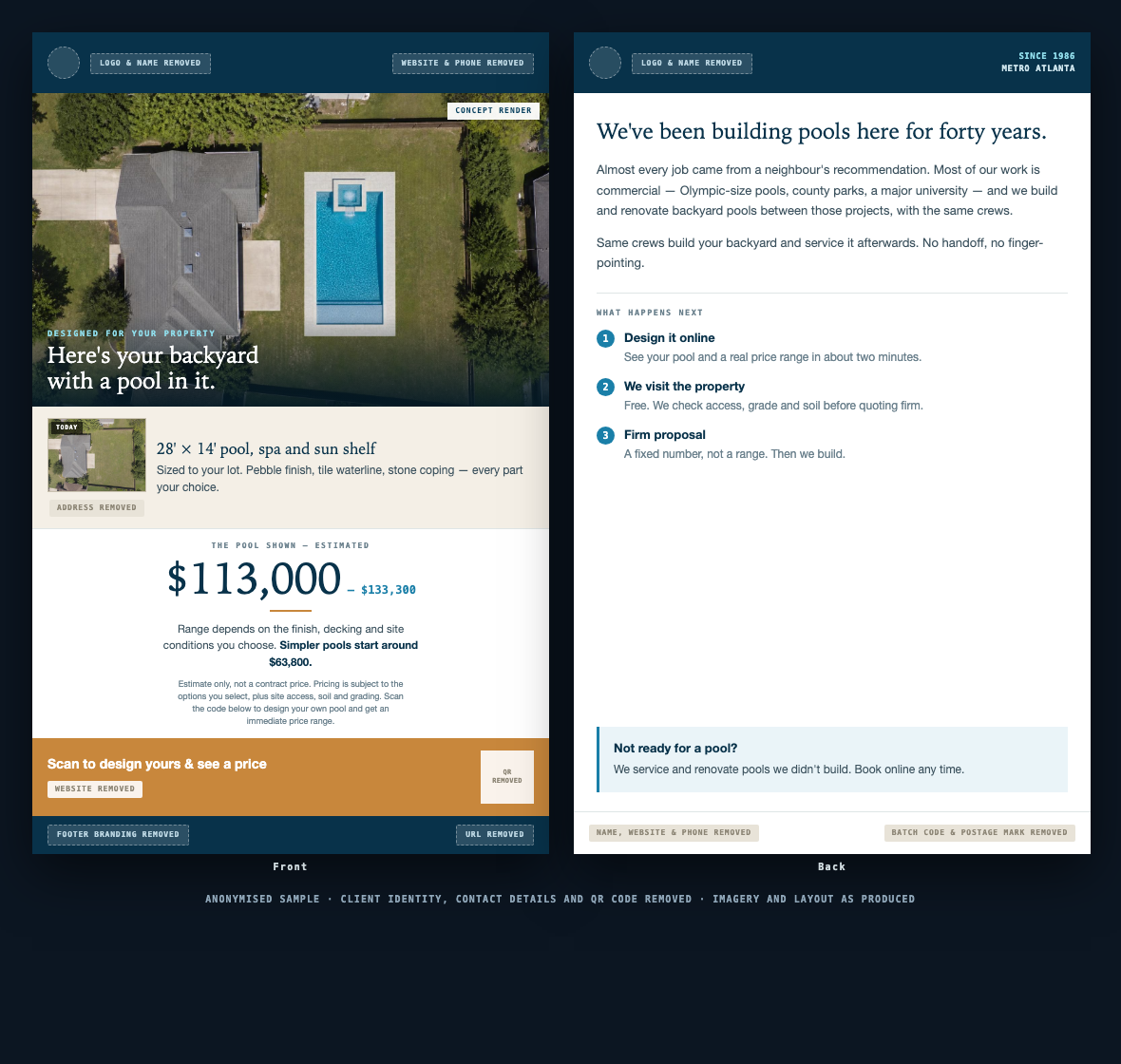
A commercial and municipal aquatics contractor in metro Atlanta — Olympic-size pools, county parks, a major university — with a residential renovation side. Four decades of work won entirely on word of mouth, and no paid acquisition of any kind before we built them one.
We show the work, not the logo. Client identities stay private unless a customer asks to be named.
The tiers follow the three connection paths above. Starter is the unconnected path — agents doing work against files, email and calendar. Operations is the connected path, which is where the CRM and attribution become possible. Website builds and hosting are quoted separately at every tier.
No CRM and no accounting connection at this tier. Agents read what you already have and hand the work back.
The first tier that can measure whether work came from anywhere, so the first that can carry lead generation.
For businesses running several lanes at once, or with more than one person who needs the pipeline.
Not more agents doing tasks. A standing boardroom that convenes on a schedule, takes positions, challenges each other on evidence, and produces finished work — then does it again the next session without being re-briefed.
Monthly is quoted rather than fixed because cost tracks meeting cadence, seat count and how much each session has to read. A weekly four-seat board and a daily eight-seat board differ by an order of magnitude, and we would rather meter it honestly than average it and be wrong in both directions.
How support actually works, what an agent run is, what happens when you exceed a tier, and the question we ask before anyone signs anything.
Read the FAQWhich agents map to work someone does by hand today, what your CRM would look like configured properly, whether we can connect to your systems, and — if it fits — what lead generation would target and cost to run.